
NAD+: why this molecule is at the center of the aging conversation
There is one molecule in your body that almost nobody thought about a few years ago - but now it is at the center of many longevity discussions.
It is called NAD+.
You do not feel NAD+ working in the way you might feel caffeine or a pre-workout. It does not give an instant boost or a dramatic effect in one day. Its role is much quieter than that - but also much more fundamental.
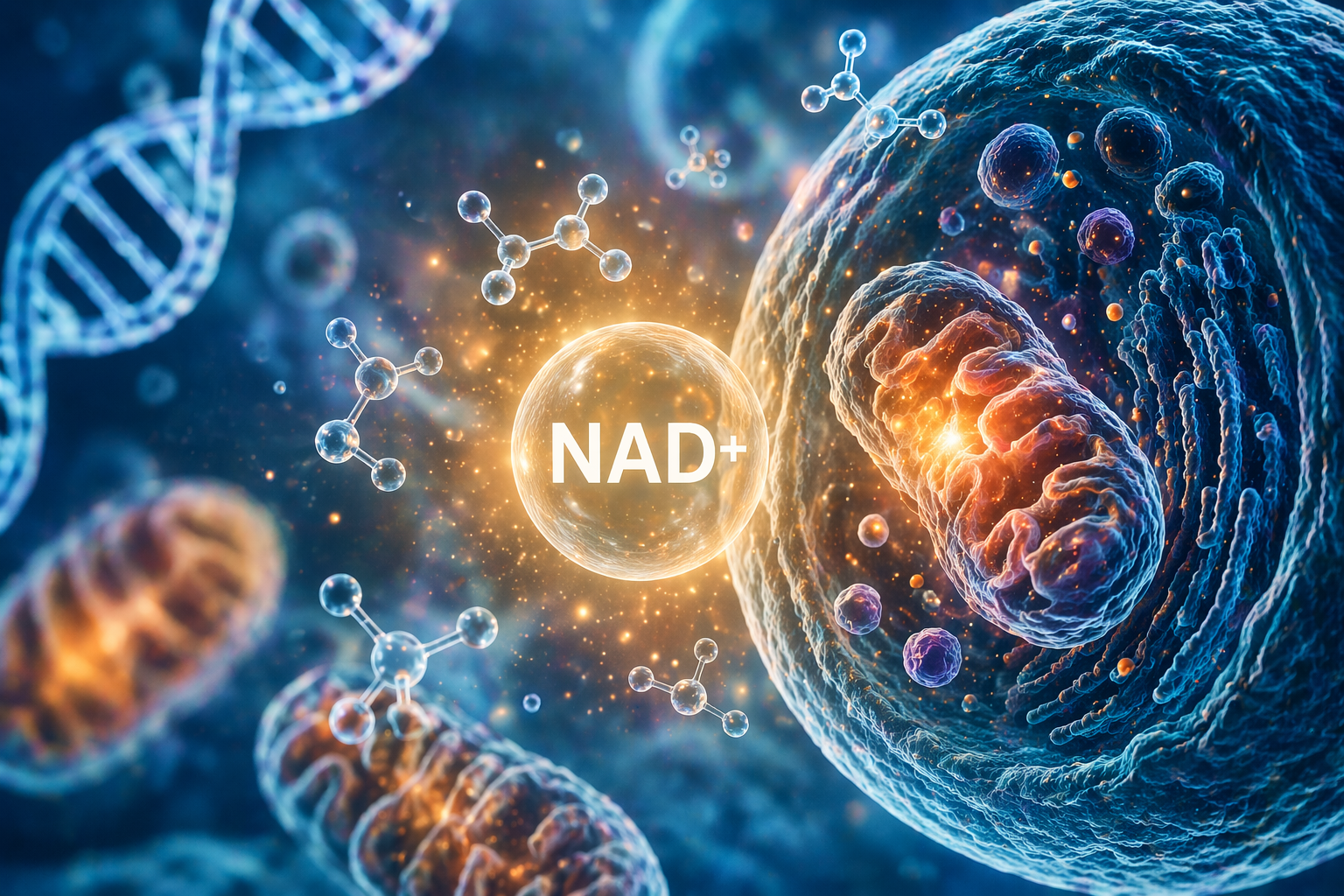
NAD+ helps your cells produce energy, repair damage, support mitochondrial function, and respond to stress. The problem is that NAD+ levels decline with age. And that decline may be one of the reasons why the body becomes less efficient over time.
That is why NAD+ is receiving so much attention right now.
A major expert review published in Nature Aging by researchers including David Sinclair, Evandro Fei Fang, and Eric Verdin brought this topic into even sharper focus. Their conclusion was clear: NAD+ sits at the center of many processes linked to aging, including energy metabolism, DNA repair, inflammation, and cellular communication.
What NAD+ actually does
NAD+ is a coenzyme, which means it helps important enzymes do their job.
One of its main roles is in the mitochondria - the part of the cell responsible for producing energy. NAD+ helps move electrons through the processes that create ATP, the main energy currency of the cell. But its role goes far beyond energy.
NAD+ is also needed by proteins called sirtuins, which help regulate gene activity, support DNA repair, reduce inflammation, and maintain mitochondrial health. It is also used by PARP enzymes, which become active when DNA damage needs to be repaired.
In simpler terms, NAD+ helps cells:
-
produce energy efficiently
-
repair DNA damage
-
manage inflammation
-
maintain healthy mitochondria
-
cope with stress more effectively
When NAD+ levels fall, these systems no longer work as well.
Why NAD+ declines with age
NAD+ levels naturally decrease over time, and several things seem to drive this process.
First, as we age, cells accumulate more DNA damage. Repairing that damage requires PARP enzymes, and these enzymes consume NAD+.
Second, an enzyme called CD38, which breaks down NAD+, tends to become more active with age and inflammation.
Third, the body becomes less efficient at recycling and rebuilding NAD+. One reason is reduced activity of NAMPT, an important enzyme in the NAD+ salvage pathway.
So with age, the body often ends up in a difficult position:
it uses more NAD+ but becomes less efficient at making it back.
That creates a gap between supply and demand.
Why researchers care so much about this
NAD+ is not interesting only because it declines with age. It is interesting because when researchers restore NAD+ in older animals, they often see improvements in important cellular functions.
A 2013 study published in Cell showed that declining NAD+ in older mice disrupted communication between the nucleus and mitochondria. Restoring NAD+ helped reverse that dysfunction.
A 2016 study published in Science found that NAD+ repletion improved mitochondrial function, supported stem cell activity, and extended lifespan in mice.
These studies helped establish NAD+ as more than a theory. They suggested that low NAD+ may actively contribute to age-related decline.
What human studies show so far
Animal studies can be exciting, but human data matters most. In humans, the best-studied ways to raise NAD+ are through precursors such as nicotinamide riboside (NR) and nicotinamide mononucleotide (NMN).
What researchers now see quite consistently is that NR and NMN can raise NAD+ levels in the body. This has been shown across multiple studies, age groups, and dose ranges.
For example, a randomized trial published in January 2026 found that 1,000 mg per day of either NR or NMN approximately doubled whole-blood NAD+ after 14 days in healthy adults.
That is an important point: the ability to raise NAD+ appears to be real and reproducible. What is less simple is the question of outcomes.
Some studies show improvements in markers linked to muscle health, inflammation, vascular function, or brain energy metabolism. But the results are not always dramatic, and they are not always easy to detect in short trials - especially in relatively healthy people.
A 2025 systematic review and meta-analysis found modest improvements in skeletal muscle mass and function, with stronger effects in older adults who already had age-related decline.
This may suggest that the people who benefit most are not necessarily the youngest or healthiest, but those whose NAD+ systems are already under stress.
NAD+ and the brain
One of the most interesting areas of NAD+ research right now is the brain.
The NADPARK trial, published in Cell Metabolism in 2022, found that NR increased NAD+ levels in the brains of people with Parkinson’s disease. Researchers also observed improvements in brain energy metabolism using MRI-based measurements.
This did not prove NR as a treatment for Parkinson’s. But it did show something very important:
oral NAD+ precursors can reach the human brain and influence its metabolic environment.
That finding opened the door to more research in neurodegeneration, cognitive decline, and post-viral fatigue states such as long COVID. These areas are still early, and much more research is needed. But the direction is promising.
Are all NAD+ precursors the same?
Not exactly. According to the expert review in Nature Aging, NR and NMN both reliably raise NAD+ and perform similarly in direct comparisons. However, not every form works the same way.
For example, plain nicotinamide (NAM) did not increase NAD+ in one comparative trial and also raised homocysteine, which may reflect extra strain on methylation pathways.
This matters because it shows that formulation matters. Raising NAD+ is not just about taking any vitamin B3-related compound and hoping for the best.
Why formulation matters
This is where a more complete NAD+ strategy becomes important.
L Cell’s Premium NAD+ Booster combines NR with apigenin.
NR works as an NAD+ precursor, helping the body build more NAD+.
Apigenin is included because it may help inhibit CD38, one of the enzymes involved in breaking down NAD+ more rapidly with age.
This creates a more thoughtful approach:
-
support NAD+ production
-
reduce some of the enzymatic pressure that lowers NAD+ over time
The formula also includes TMG (trimethylglycine), which helps support methylation. This is relevant because NAD+ metabolism can increase methylation demand, and supporting that pathway may be useful in a more complete formulation.
In other words, the goal is not only to add a precursor, but to support the broader metabolic context around NAD+.
NAD+ is not just another health trend. It is a molecule involved in some of the most important systems linked to aging: energy production, DNA repair, mitochondrial health, inflammation, and cellular resilience.
Its decline appears to be one of the recurring biological changes that happens with age. And while human research is still developing, the field is becoming stronger, more detailed, and more clinically relevant.
That is why NAD+ is now at the center of the aging conversation.
Not because it promises a quick fix - but because it plays such a foundational role in how cells function over time.
Scientific sources
Gomes AP et al. (2013). Declining NAD+ induces a pseudohypoxic state disrupting nuclear-mitochondrial communication during aging. Cell.
Zhang H et al. (2016). NAD repletion improves mitochondrial and stem cell function and enhances lifespan in mice.Science.
Brakedal B et al. (2022). The NADPARK study: a randomized Phase I trial of nicotinamide riboside supplementation in Parkinson’s disease. Cell Metabolism.
Prokopidis K et al. (2025). The effect of NMN and NR on skeletal muscle mass and function: a systematic review and meta-analysis. Journal of Cachexia, Sarcopenia and Muscle.
Abdellatif M et al. (2025). Autophagy is required for the therapeutic effects of the NAD+ precursor nicotinamide in obesity-related heart failure. European Heart Journal.
Szarvas Z et al. (2025). Effects of NAD+ supplementation with oral NR on vascular health and cognitive function in older adults with peripheral artery disease. Journal of Pharmacology and Experimental Therapeutics.
Zhang J, Fang EF, Sinclair DA et al. (2025). Emerging strategies, applications and challenges of targeting NAD+ in the clinic. Nature Aging.


Leave a comment
This site is protected by hCaptcha and the hCaptcha Privacy Policy and Terms of Service apply.