

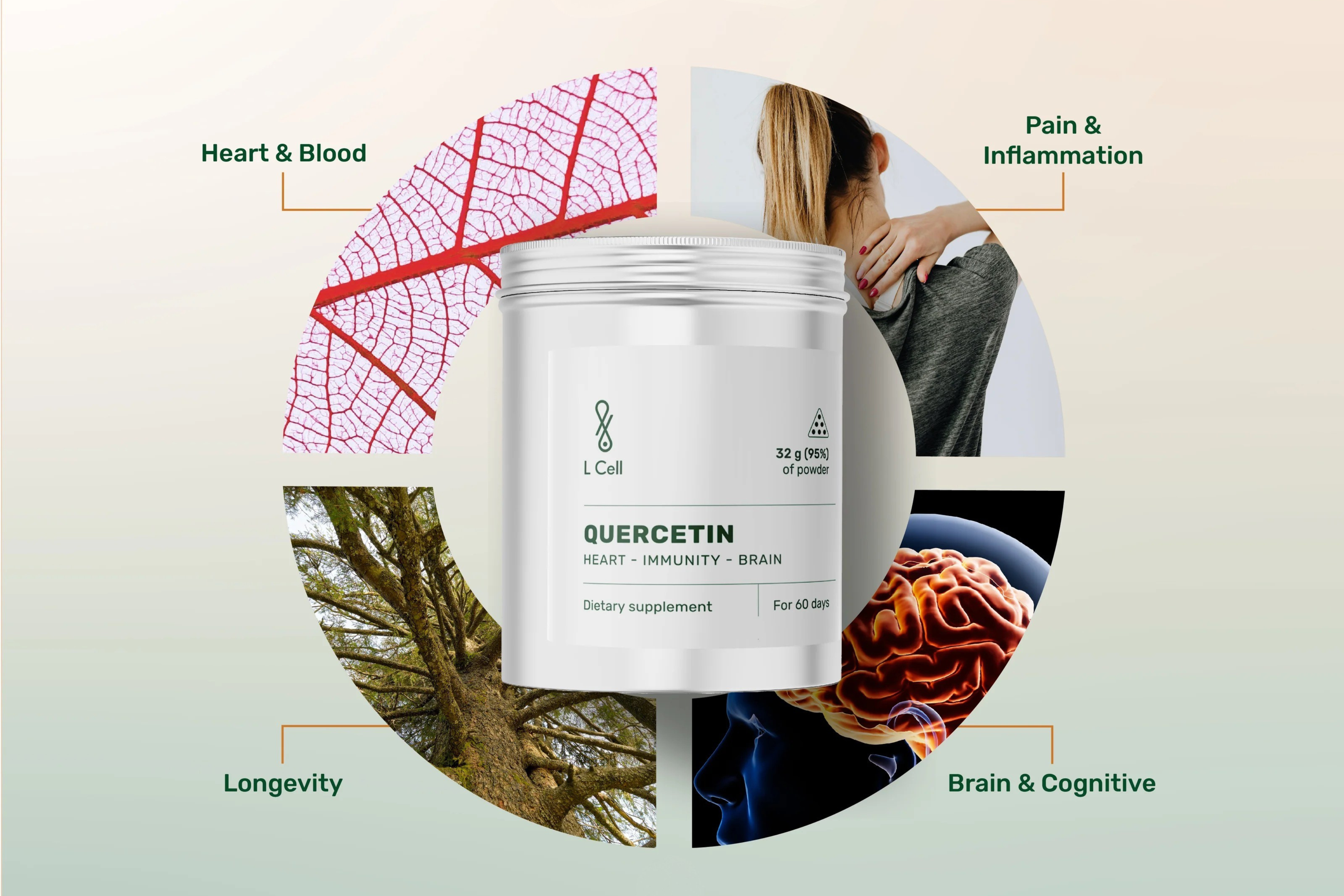
Quercetin: why this flavonoid matters in the context of healthy aging?
In longevity science, some compounds stand out not because they create a strong or immediate effect, but because they support systems that matter over time. Quercetin is one of those compounds.
Quercetin is a naturally occurring plant flavonoid found in foods like onions, apples, berries, and capers. It has been studied for its potential role in oxidative stress, inflammation, vascular health, and cellular aging.
It is often described simply as an antioxidant, but that does not fully explain why researchers are interested in it. Quercetin has been studied not only for how it interacts with free radicals, but also for how it may affect cell signaling, inflammatory pathways, blood vessel function, and cellular senescence.
At the same time, the science is not straightforward. Human studies show some promising results, but they are not always consistent. One of the main reasons is that quercetin is not absorbed equally well in every form, and its effects can depend on the person, the dose, and the formulation used.
To understand quercetin properly, it helps to look at what it is, how it behaves in the body, and what the research actually shows.
What is quercetin?
Quercetin is a flavonol, which is a type of flavonoid naturally found in many plant foods.
After quercetin is consumed, the body does not keep it in its original form for long. It is quickly processed in the intestine and liver, and what ends up circulating in the blood are mostly quercetin metabolites, not free quercetin itself. This is important because it helps explain why quercetin does not work as simply as people often assume.
In other words, quercetin may come from food or supplements, but the body experiences it in a more complex way than the label on the bottle suggests.
This also explains why different quercetin supplements may not have the same effect. The amount absorbed into the bloodstream can vary depending on the formulation, which is one of the key challenges in quercetin research.
Quercetin and oxidative stress
One of the main reasons quercetin has attracted scientific interest is its relationship with oxidative stress.
Oxidative stress is a normal part of life, but when it becomes excessive or poorly controlled, it can contribute to cellular damage over time. Quercetin has been studied because it may help the body respond to oxidative stress more effectively.
In one human study involving patients with sarcoidosis, quercetin supplementation reduced markers of both oxidative stress and inflammation. Interestingly, the strongest effects were seen in people who already had higher levels of oxidative stress to begin with.
This suggests that quercetin may be more useful in situations where the body is already under greater stress, rather than acting like a general “boost” for everyone.
Still, results are not always consistent. In one randomized trial in healthy people, quercetin increased blood quercetin levels in a dose-dependent way, but did not significantly improve several markers related to antioxidant status, inflammation, or metabolism.
So while the biological theory behind quercetin is strong, the actual measurable effects in humans seem to depend a lot on context.
Inflammation and immune signaling
Quercetin has also been studied for how it may affect inflammatory signaling. A lot of the early interest comes from preclinical research, where quercetin appears to influence pathways involved in inflammation, including those linked to inflammatory cytokines and cell signaling systems like NF-κB.
In human research, the picture is more mixed. For example, in the sarcoidosis study, quercetin was associated with lower markers of inflammation. But in another trial involving overweight people with higher cardiovascular risk, quercetin improved some vascular markers, yet did not significantly change inflammatory markers such as TNF-α or C-reactive protein.
This shows that quercetin does not seem to act like a broad anti-inflammatory switch in every person or every condition. Its effects may be more noticeable in certain populations, under specific types of stress, or in tissues that are not fully reflected by standard blood markers.
Quercetin and cardiovascular health
One of the more practical and relevant areas of quercetin research is cardiovascular and vascular health.
Several human studies have looked at whether quercetin can influence factors such as blood pressure, endothelial function, and oxidized LDL.
In a double-blind, placebo-controlled crossover study in overweight individuals with a higher cardiovascular risk profile, quercetin lowered systolic blood pressure and oxidized LDL. In another study, a quercetin-rich onion skin extract reduced 24-hour ambulatory blood pressure in patients with hypertension.
These results are encouraging, but they should still be interpreted carefully. Quercetin is not a replacement for medical treatment, and the improvements seen in studies are generally modest rather than dramatic.
A more accurate way to think about it is that quercetin may help support certain aspects of vascular health, especially in people who already show signs of cardiometabolic strain.
Quercetin, cellular senescence, and longevity
Quercetin has become especially interesting in longevity science because of its role in senolytic research. Senolytics are compounds being studied for their ability to help clear senescent cells. These are cells that no longer divide normally but remain active in ways that may contribute to chronic inflammation and tissue dysfunction over time.
This part of quercetin research gets a lot of attention, but it is important to be precise here. Most of the human senolytic research does not study quercetin on its own. Instead, the main studies involve dasatinib plus quercetin, often referred to as D+Q.
In an early clinical study involving people with diabetic kidney disease, this combination reduced markers of senescent cells in adipose tissue. Another pilot study in people with idiopathic pulmonary fibrosis reported improved physical function and supported the idea that senolytic approaches may be feasible in humans.
This makes quercetin relevant to discussions about aging biology, but it does not mean quercetin alone has been proven to act as a senolytic in humans. At this stage, the human evidence is still early, limited, and mostly based on combination therapy rather than quercetin by itself.
Bioavailability: one of the biggest limitations
One of the biggest challenges in quercetin research is bioavailability, meaning how well it is absorbed and used by the body.
Human studies show that quercetin is extensively metabolized, and blood levels can vary a lot depending on the form used. This is one of the main reasons why strong laboratory data do not always translate into equally strong real-world results.
More recent pharmacokinetic studies comparing different quercetin formulations have shown that some forms lead to much better absorption than others.
In practical terms, this means that two products containing the same number of milligrams of quercetin may not behave the same way in the body.
This does not reduce quercetin’s scientific relevance. It simply means that its effects depend not only on the compound itself, but also on how it is delivered.
A systems view
Quercetin matters in the healthy aging conversation because it sits at the intersection of several important biological systems.
It has been studied in relation to:
-
oxidative stress,
-
inflammatory signaling,
-
vascular health,
-
and cellular senescence.
That does not make it a miracle molecule. But it does make it a compound with broad biological relevance.
The most realistic way to understand quercetin is not as a shortcut or a dramatic anti-aging solution, but as a supportive compound that may interact with pathways involved in how the body handles stress over time.
Its value lies in this broader systems-level role, especially when considered in the right context and with realistic expectations.
Conclusion
Quercetin is a widely studied flavonoid with potential relevance to oxidative stress, inflammation, vascular function, and aging biology.
Human studies suggest that it may help improve certain markers, such as systolic blood pressure, oxidized LDL, and some oxidative stress markers, especially in selected populations. It has also become an important compound in early senolytic research, particularly in combination with dasatinib.
At the same time, the science is not uniform. Quercetin’s poor and variable bioavailability remains one of the biggest reasons why study results are not always consistent.
In the context of longevity, quercetin is best seen as a biologically interesting compound that may support how the body responds to stress over time. It is relevant, but it should be discussed carefully and realistically — with precision, not hype.
Scientific sources used
-
Boots AW et al. (2011). Quercetin reduces markers of oxidative stress and inflammation in sarcoidosis. Clinical Nutrition.
-
Egert S et al. (2008). Daily quercetin supplementation dose-dependently increases plasma quercetin concentrations in healthy humans. Journal of Nutrition.
-
Egert S et al. (2009). Quercetin reduces systolic blood pressure and plasma oxidised LDL concentrations in overweight subjects with a high-cardiovascular disease risk phenotype. British Journal of Nutrition.
-
Brüll V et al. (2015). Effects of a quercetin-rich onion skin extract on 24 h ambulatory blood pressure in hypertensive patients. British Journal of Nutrition.
-
Graefe EU et al. (2001). Pharmacokinetics and bioavailability of quercetin glycosides in humans. Journal of Clinical Pharmacology.
-
Solnier J et al. (2023). A Pharmacokinetic Study of Different Quercetin Formulations in Healthy Participants. Antioxidants.
-
Riva A et al. (2019). Improved Oral Absorption of Quercetin from Quercetin Phytosome. Journal of Agricultural and Food Chemistry.
-
Hickson LTJ et al. (2019). Senolytics decrease senescent cells in humans: Preliminary report from a clinical trial of Dasatinib plus Quercetin in individuals with diabetic kidney disease. EBioMedicine.
-
Justice JN et al. (2019). Senolytics in idiopathic pulmonary fibrosis. EBioMedicine.

Leave a comment
This site is protected by hCaptcha and the hCaptcha Privacy Policy and Terms of Service apply.