

Article: Why the most studied supplement in sport is becoming one of the most interesting in longevity?
Why the most studied supplement in sport is becoming one of the most interesting in longevity?
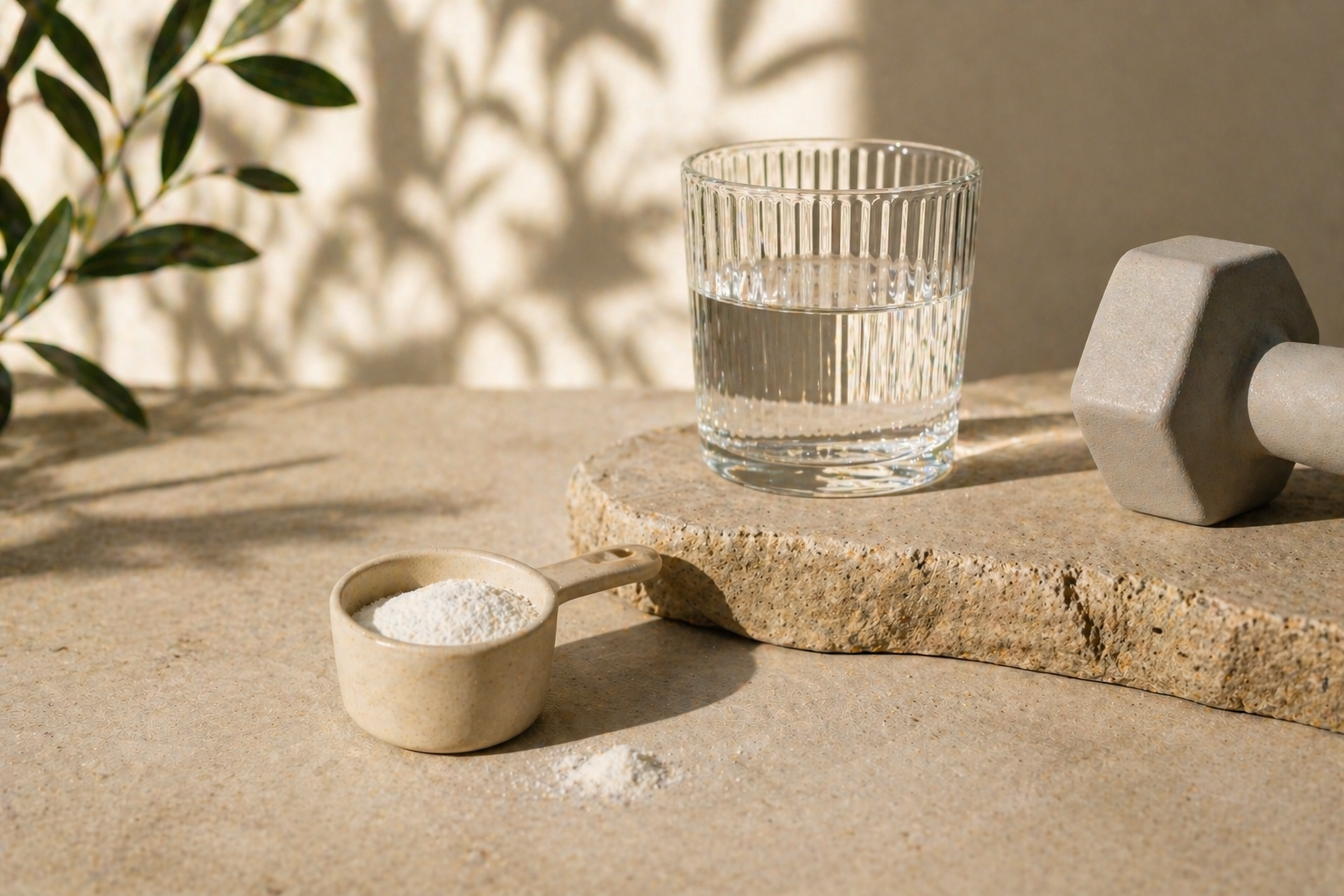
For most people creatine belongs in the world of gym bags and protein shakes - something athletes take to lift heavier. That association is not wrong, but it is incomplete. Over the past few years, a growing body of research has quietly repositioned creatine as something more interesting: a compound with direct relevance to how muscles, the brain, and cellular energy systems hold up as the body ages.
The research base behind creatine is unlike almost anything else in nutritional science. In 2025, Dr. Richard Kreider and colleagues at Texas A&M University published a comprehensive analysis of 685 clinical trials involving creatine supplementation, concluding that there were no significant differences in the rate of side effects between creatine and placebo groups across the entire body of clinical evidence. No other dietary supplement has been tested at this scale. The safety question, in other words, is settled. What remains open, and increasingly interesting, is the question of what creatine actually does across the full arc of aging.
What creatine does in the cell
Creatine is a naturally occurring compound synthesized in the liver and kidneys from three amino acids: arginine, glycine, and methionine. It is also found in meat and fish, which is why vegetarians and vegans tend to have significantly lower baseline levels. Once inside the cell, creatine is phosphorylated into phosphocreatine, which acts as a rapid energy reserve. When ATP - the cell's primary energy currency - is depleted during high-demand activity, phosphocreatine donates its phosphate group to regenerate it almost instantly. This is the mechanism that makes creatine useful in short, intense bursts of physical effort.
But the energy buffering role of creatine extends beyond exercise. Mechanistically, creatine supports energy metabolism, mitochondrial stability, and antioxidant defenses - all of which become more relevant, not less, as the body ages and cellular energy systems gradually become less efficient. Mitochondria in aged cells produce less ATP, recover more slowly from stress, and are more prone to producing reactive oxygen species. Maintaining phosphocreatine availability helps buffer these inefficiencies, keeping cells functional under conditions where energy demand exceeds supply.
The muscle-aging connection
Creatine stores naturally decline with age due to reduced dietary intake, impaired endogenous synthesis, physical inactivity, and loss of muscle mass - contributing not only to sarcopenia and functional decline but also to increased risk of chronic diseases where creatine plays a key role.
Sarcopenia - the progressive loss of skeletal muscle mass and strength with age - is one of the strongest predictors of long-term health outcomes in older adults. It is associated with falls, fractures, metabolic dysfunction, and reduced independence. Clinical trials and meta-analyses show that creatine supplementation at 5g per day or more, when combined with resistance training, significantly improves muscle strength, lean mass, and functional performance in adults aged 50 to 80 and beyond, reducing the risk of frailty, muscle wasting, and falls.
The important qualifier here is the combination with exercise. Creatine alone is unlikely to produce meaningful benefits without exercise and supportive lifestyle interventions. This is not a weakness of the compound - it is an honest reflection of how muscle biology works. Creatine enhances the cellular environment in which training adaptations happen. It allows muscles to train harder, recover faster, and build more effectively. In older adults whose capacity for intense training is limited, this support becomes particularly meaningful.
The brain: an emerging frontier
The less familiar side of creatine's biology concerns the brain. Neural tissue has high and continuous energy demands, and phosphocreatine plays a role in maintaining ATP availability in neurons just as it does in muscle cells. A 2026 review in Frontiers in Nutrition explored the muscle-brain axis as a key pathway linking skeletal muscle health to cognitive performance, finding that creatine supplementation combined with resistance training produced modest improvements in memory, processing speed, and executive function - especially in individuals with lower baseline creatine levels.
The cognitive effects are real but more modest and less consistent than the muscle effects, partly for a physiological reason. A key uncertainty is whether supplemented creatine crosses the blood-brain barrier in sufficient quantities to affect neuronal metabolism - and while some studies show modest brain creatine increases, methodological constraints and individual variability limit firm conclusions. This is an honest limitation worth acknowledging. The brain data is promising but not as definitive as the muscle data, and the people who appear to benefit most are those with the lowest baseline levels - vegetarians, older adults, and individuals under significant cognitive stress.
What is clear is that the brain and muscle are not independent systems in aging. Muscle tissue produces signaling molecules called myokines during exercise, which cross into the brain and support neuroplasticity, reduce neuroinflammation, and promote the growth of new neural connections. Creatine, by enabling better muscle function and more effective training, may support brain health partly through this indirect pathway - the muscle acting as a signaling organ for the brain.
A 2025 safety landmark
Beyond the 685-trial safety analysis, a comprehensive narrative review published in the Journal of the International Society of Sports Nutrition in 2025 (Candow, Ostojic, Chilibeck et al.) specifically addressed creatine in older adults and clinical populations. It concluded that creatine monohydrate supplementation is both safe and effective for aging populations, supports lean mass and functional outcomes when combined with exercise, and warrants broader consideration as a standard component of healthy aging strategies - not just an athletic aid.
This represents a meaningful shift in how the longevity and clinical nutrition community is framing creatine. It is not being rebranded or oversold. It is being recognized for what decades of research have consistently shown: a well-tolerated, inexpensive, and effective tool for maintaining the cellular energy infrastructure that aging gradually erodes.
Conclusion
Creatine is not a new discovery or a longevity trend. It is one of the most thoroughly studied nutritional compounds in existence, and the picture that research has built over decades is consistent: it works, it is safe, and its relevance grows rather than shrinks with age. The muscle benefits are well-established. The brain data is developing in an interesting direction. And the cellular energy logic - maintaining phosphocreatine availability as mitochondrial efficiency declines - makes biological sense at every level.
For anyone thinking seriously about maintaining physical and cognitive function across the decades, creatine belongs in that conversation. Not because it is exciting, but because the evidence says it matters.
Scientific sources
- Kreider RB et al. (2025). Safety of creatine supplementation: analysis of 685 clinical trials. Journal of the International Society of Sports Nutrition.
- Candow DG et al. (2025). Creatine monohydrate supplementation for older adults and clinical populations. Journal of the International Society of Sports Nutrition.
- Li N (2026). Creatine supplementation and exercise in aging: a narrative review of the muscle-brain axis. Frontiers in Nutrition.
- Machado M (2025). Creatine supplementation and cognitive aging: the challenge of crossing the blood-brain barrier. Nutrition Reviews.


Leave a comment
This site is protected by hCaptcha and the hCaptcha Privacy Policy and Terms of Service apply.